
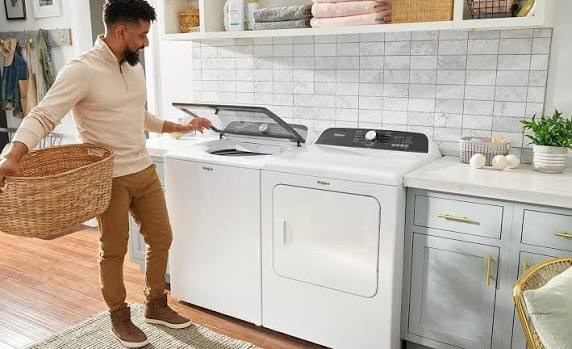
Studies suggest that top-load washing machines last longer than front-load ones. Top-load washing machines run fewer cycles because they’re larger. In most small rented flats in India, top-load machines are widely used because they’re cheaper. Top-load machines don’t need a stand and can run cycles with low water pressure. On the other hand, front-load washing machines can clean better and use less water – if you are paying water bills, this is one factor to consider.
That summary hides the details that actually decide the purchase, and those details matter more in a rented home than in an owned one. Tank height, floor level, counter depth and notice period are all someone else’s decisions. The top-load vs front-load washing machine debate also reads differently on a monthly plan than at a showroom — listings for a washing machine on rent on platforms like Rentomojo carry both types side by side, at very different rates.
Top-Load vs Front-Load Washing Machines: What Makes the Difference?
It’s the drum axis. A top-load washing machine spins around a vertical axis and cleans by moving clothes through a large volume of water. A front-load washing machine spins around a horizontal axis and cleans by lifting clothes and dropping them back.
| Factor | Top-load | Front-load |
| Drum axis | Vertical | Horizontal |
| Loading posture | Standing | Bending or kneeling |
| Water per cycle | Up to 120 litres | 40–60 litres |
| Energy use | Baseline | 25–30% lower |
| Typical cycle length | Shorter | Close to twice as long |
| Adding clothes mid-wash | Possible on most models | Door locks once running |
| Fits under a counter | No | Yes |
| Purchase and rental price | Lower | Higher |
Does a Top-Load or Front-Load Machine Take Up More Space?
While footprints are close, what differs is the clearance each one demands around it.
Does a Front-Load Washing Machine Need a Stand?
No. Whirlpool installation guidance says the machine rests on a level, solid floor with all four feet in firm contact, with or without a pedestal. Stands are optional accessories that lift the door to a comfortable height. The real requirement is a floor that does not flex, which rules out some older tiled balconies.
Which Washing Machine Handles a Rented Flat’s Water Supply Better?
Both fully automatic types run on tank or mains pressure. Popular brands like Bosch and LG both specify a minimum of 0.3 bar for their India models, which is roughly a three-metre column of water above the inlet. Pressure climbs about 0.1 bar for every additional metre of tank height.
| Supply situation | Workable option |
| Overhead tank 3m or more above the inlet | Top-load or front-load |
| Low tank or ground-floor supply | Semi-automatic, or a pressure pump |
| Intermittent municipal supply | Top-load — shorter cycles, easier to restart |
| Metered or tanker-supplied water | Front-load — roughly half the water |
Top-Load vs Front-Load Washing Machine: Which Suits Bachelors?
Cycle length decides this one. A front-load washing machine typically runs close to twice as long as a top-load washing machine for the same load, because it compensates for less water with more tumbling time. For a weekend batch, that is irrelevant. For a shirt needed before a nine o’clock standup, it is the whole argument.
Which Makes More Sense in a Home You May Not Permanently Stay In?
Here the answer shifts. An eleven-month lease and a machine with an eight-to-ten-year working life are badly matched timeframes, and a front loader is harder to move — heavier, and its transit bolts have to go back in before it travels.
Monthly pricing reflects the same gap. On Rentomojo’s listings, the spread runs like this:
| Type | Monthly rental |
| Semi-automatic | From ₹414 |
| Fully automatic top-load, 6.5–7 kg | ₹625–₹1,028 |
| Fully automatic front-load, 7–8 kg | ₹1,528–₹1,782 |
A front-load washing machine costs roughly twice as much per month as a comparable top-load washing machine. The gap is wider than showroom prices suggest because the premium recurs monthly instead of being absorbed once. Anyone deciding whether to rent a washing machine or buy one outright should work from that ratio rather than the sticker price.
Final Thoughts
If you’re debating top-load vs. front-load for a small rented flat, a top-loader will likely win. It happens largely for reasons unrelated to wash quality: the convenience of needing no stand, tolerance for weak pressure, quicker cycles, easier to move, and cheaper monthly. Front loaders earn their place where water is metered or scarce, where the machine slides under a counter, and where laundry runs to a schedule rather than a deadline.